RLinf as an RL Backend for Dexbotic
Overview
Dexbotic can now launch reinforcement learning post-training directly from the Dexbotic repository while using RLinf as the distributed RL backend.
Previously, users started embodied RL jobs from the RLinf side, for example with
RLinf/examples/embodiment/train_embodied_agent.py. That workflow works well for
RLinf-native models, but it asks Dexbotic users to move model wiring, checkpoint
paths, model adapters, and task configs into an external training entrypoint.
The new flow keeps Dexbotic as the user-facing entry:
python -m dexbotic.rl.model_rl_libero_pi0 --suite=libero_goalDexbotic owns the model definition, policy adapter, and experiment config. RLinf
provides the backend services that are hard to rebuild well: cluster launch,
worker placement, rollout collection, environment workers, FSDP actor training,
checkpointing, logging, and embodied RL orchestration.
This update supports dexbotic_pi0 and dexbotic_dm0.
Runtime Environment
This workflow still depends on the RLinf embodied runtime. In practice, Dexbotic
is the launch entrypoint, while the Python environment must include the RLinf
installation and its embodied dependencies for Dexbotic models and the
maniskill_libero environment.
One proven setup is to install the RLinf environment from the RLinf repository:
git clone https://github.com/RLinf/RLinf.git
cd RLinf
bash requirements/install.sh embodied \
  --venv /your/venv/name \
  --model dexbotic \
  --env maniskill_libero
source /your/venv/name/bin/activate
After that, run the RL job from the Dexbotic repository, not from the RLinf repository:
cd /path/to/dexbotic
python -m dexbotic.rl.model_rl_libero_pi0 --suite=libero_goal
Why This Is Better
- Dexbotic is the single entrypoint. Users stay in the Dexbotic project for model development, SFT checkpoints, RL configs, and launch commands.
- RLinf remains the RL engine. The same RLinf
Cluster,HybridComponentPlacement, worker groups, andEmbodiedRunnerare reused without forking the RLinf training loop. - Models are registered dynamically. Dexbotic registers model builders into
RLinf at runtime with
rlinf.models.register_model, so RLinf can instantiate Dexbotic policies bymodel_typejust like built-in RLinf models. - No patching RLinf for every Dexbotic model. New Dexbotic policies can be exposed through a small registry bridge instead of modifying RLinf internals.
- A smoother open-source experience. Fine-tuning, RL post-training, and evaluation all feel like Dexbotic workflows, while advanced users can still override Hydra configs and RLinf backend settings.
Architecture
The integration has three small layers:
-
dexbotic.rl.model_rl_libero_pi0This is the Dexbotic-side Hydra entrypoint. It selects a local RL config such as
libero_goal_ppo_dexbotic_pi0.yaml, registers Dexbotic model builders, and calls the shared RL launcher. -
dexbotic.rl.rlinf_registryThis module bridges Dexbotic models into RLinf. It registers entries such as
dexbotic_pi0anddexbotic_dm0throughregister_model(...). The same module also exposes aregister()hook so RLinf Ray workers can load the registry throughRLINF_EXT_MODULE. -
dexbotic.rl._embodied_cliThis is the thin backend adapter. It validates the Hydra config with RLinf, creates the RLinf cluster and placement strategy, launches actor, rollout, and environment worker groups, then starts
EmbodiedRunner.
Conceptually, the launch path is:
Dexbotic CLI
  -> Dexbotic Hydra RL config
  -> Dexbotic model registration
  -> RLinf config validation
  -> RLinf Cluster / Placement
  -> RLinf Actor + Rollout + Env workers
  -> RLinf EmbodiedRunner
Dynamic Model Registration
RLinf discovers models by model_type. Dexbotic uses that mechanism instead of
copying Dexbotic model code into RLinf:
from rlinf.models import register_model

register_model("dexbotic_pi0", build_dexbotic_pi0, category="embodied", force=True)
During launch, Dexbotic registers the model in the driver process before RLinf validates or instantiates the policy. For distributed workers, Dexbotic sets:
RLINF_EXT_MODULE=dexbotic.rl.rlinf_registryRLinf imports that module in each worker process and calls register(), giving
the driver and all workers the same custom model_type registry. This is the key
piece that makes RLinf feel like a backend rather than a separate application.
Running PPO on LIBERO
Start from the Dexbotic repository and choose a LIBERO suite:
python -m dexbotic.rl.model_rl_libero_pi0 --suite=libero_goalSupported suites:
libero_10libero_90libero_goallibero_objectlibero_spatial
You can also use Hydra directly:
python -m dexbotic.rl.model_rl_libero_pi0 \
  --config-name=libero_10_ppo_dexbotic_pi0 \
  actor.model.model_path=/path/to/dexbotic-pi0-checkpoint \
  rollout.model.model_path=/path/to/dexbotic-pi0-checkpoint
The RL configs live under:
dexbotic/config/rl/For example, libero_goal_ppo_dexbotic_pi0.yaml composes:
env/libero_goalmodel/dexbotic_pi0training_backend/fsdp- PPO, rollout, logging, and checkpoint settings
Launch Validation
When the job is started through the Dexbotic-side backend integration, the launcher prints the following marker before RLinf creates the cluster and workers:
[Dexbotic RL] Launching from Dexbotic entrypoint with RLinf as backend.If this line appears in the startup logs, it confirms that the run was launched from Dexbotic and that RLinf is being used as the backend rather than as the top-level frontend CLI.
Frontend vs Backend
There are two valid ways to run the same RLinf-powered training stack:
- RLinf as frontend: start from the RLinf repository and launch RL directly with RLinf entry scripts.
- RLinf as backend: start from the Dexbotic repository and let Dexbotic call into RLinf for cluster launch, rollout workers, actor workers, and the runner.
For the same policy, algorithm, and effective config, these two launch styles should produce the same behavior and training results. The difference is the entrypoint and user experience, not the underlying RL execution engine.
The figure below summarizes both perspectives together: it includes frontend/backend comparison views and additional training-effect results in one place.
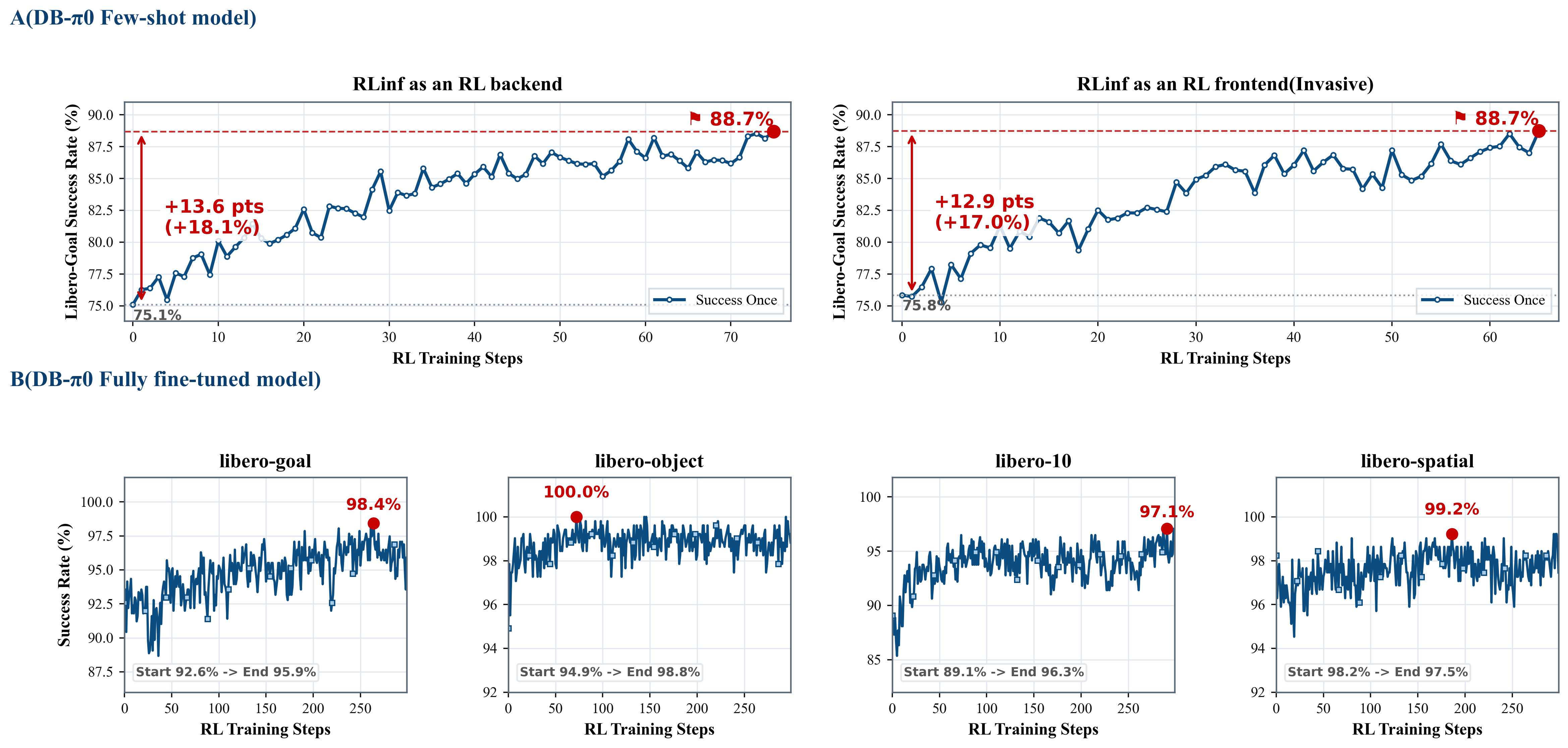
In other words, Dexbotic-as-entrypoint is intended to be operationally smoother for Dexbotic users, while keeping training semantics aligned with the original RLinf workflow.
Extending to New Dexbotic Policies
To add another Dexbotic policy as an RLinf-backed RL model:
- Implement a policy adapter under
dexbotic/rl/rlinf_bridge/. - Expose a
get_model(cfg, torch_dtype)function that returns an RLinf-compatible policy. - Register a new
model_typeindexbotic.rl.rlinf_registry. - Add a model config under
dexbotic/config/rl/model/. - Compose it into a task config under
dexbotic/config/rl/. - Launch from Dexbotic with a small CLI entrypoint or a Hydra
--config-nameoverride.
This keeps the integration modular: Dexbotic evolves its model zoo and adapters, while RLinf continues to handle scalable RL execution.
Design Principle
The goal is not to hide RLinf. The goal is to put each project in its strongest role:
- Dexbotic provides the robot policy, checkpoint lineage, model-specific data transforms, and user-facing experiment entrypoint.
- RLinf provides the reliable distributed RL backend for rollouts, optimization, placement, logging, and runner orchestration.
With this split, RL post-training becomes a natural continuation of Dexbotic model development: register the policy, point the config at a checkpoint, and launch RL from the same place where the model was built.